Scientific Hosting
Scientific hosting at La Palma
Dark Sky Hosting is a registered I+D+i company built by engineers. Our scientific hosting goes beyond pier space — we offer infrastructure designed for programmes that generate publishable data, feed international networks, and require guaranteed access without telescope queue scheduling.
Disciplines we support
🌟 Stellar spectrometry
Supernovae classification, cataclysmic variable monitoring, stellar evolution studies. Compatible with DADOS, Shelyak ALPY, LISA and high-resolution echelle spectrographs. Fibre-fed configurations supported.
🪐 Exoplanet photometry
Transit timing, depth measurement and ephemeris refinement. Differential photometry pipelines. Submissions to TESS follow-up, ExoClock and AAVSO. Millimagnitude precision routinely achieved at our site.
🛰️ Space Situational Awareness
Astrometric and photometric characterisation of LEO, MEO and GEO objects. Sub-arcsecond solutions. Automated pipeline delivery. Active clients include commercial SSA operators at global scale.
☄️ Astrometry · Comets & Minor Planets
MPC-format positional data. Comet nuclear monitoring and fragmentation alerts. Near-Earth Object follow-up. Low western horizon for post-conjunction access.
📈 Variable star photometry
Long-period variables, Mira stars, RR Lyrae, eclipsing binaries. AAVSO and VSX-compatible data pipelines. Multi-year datasets for period change analysis.
🔭 Deep imaging & time-domain
Narrowband and broadband imaging of nebulae, galaxies and transients. Nova and supernova discovery follow-up. Time-critical ToO (Target of Opportunity) response within the same night.
What makes it different from standard hosting
- Raw data access — FITS files delivered in real time to your data storage via VPN. No pre-processing unless you request it.
- Server-side scripting — run your own Python or shell pipelines on our local edge server, co-located with the instrument. Latency-free data reduction for time-critical work.
- Custom electronics — we design and manufacture focusers, rotators, safety monitors and control hardware. If your instrument needs a bespoke interface, we build it.
- ASCOM/ALPACA native — N.I.N.A., ACP, Voyager, SGP and any other ASCOM-compatible platform connects as if the hardware were local, over VPN.
- Weather safety automation — our DarkSkyRoof system closes on unsafe conditions autonomously and reopens when safe, even without human supervision.
- Site statistics on request — 25+ years of local observations and three years of automated SQM, seeing and meteorological data available to prospective clients.
Site specifications
| Parameter | Value |
|---|---|
| Altitude | 1,360 m a.s.l. — above the marine inversion layer |
| Sky darkness (SQM new moon) | up to 22.03 mag/arcsec² — Bortle 1–2 |
| Median seeing (FWHM) | ≥ 1 arcsec — above the marine inversion layer |
| Clear nights per year | 311+ clear nights/year (IAC 5-year average) |
| Horizon | Low all-round · excellent western access |
| Power | 230V 50Hz · LiFePO4 60 kW + grid · hybrid solar inverters · 0 ms |
| Internet | Radioenlace 1G+1G + 2× Starlink + 2× LTE 4G+/5G |
| Roof system | DarkSkyRoof automated · ASCOM/ALPACA |
| Remote access | ASCOM/ALPACA platform · direct FITS delivery · client-managed VPN |
Interested in a scientific programme?
We evaluate each proposal on its scientific merit and logistical fit. If you are planning a multi-night, multi-season or long-term campaign, contact us through the scientific track in our contact form.
Discuss your programme →Science happening here, every clear night
These are real spectra obtained from our facility. Not simulations, not stock images — data collected with a 14″ telescope and spectrograph permanently hosted at our site.
David Cejudo — resident spectroscopist
David Cejudo has his 14″ telescope and high-resolution spectrograph permanently installed at our facility, observing every clear night. His work spans cataclysmic variable monitoring (contributing to CBA network publications in MNRAS), recurrent nova spectroscopy, and night-sky emission studies. The spectra below were obtained at our site and are representative of what the sky and the science look like from La Palma.
![Airglow emission spectrum La Palma — [OI] 5577, Na I 5890 · David Cejudo](/wp-content/uploads/2026/04/spectrum-airglow-original.png)
Airglow — the only emission the sky produces
This is the emission spectrum of the night sky at our site. The only lines present are natural: [O I] 5577 Å (forbidden oxygen, upper mesosphere ~90 km), Na I 5890 Å (sodium from meteoric ablation), and a barely detectable [O I] 6300/6364 Å pair.
There is no mercury, no sodium street lighting, no LED broadband contamination. The sodium line varies night to night and with pointing direction — its source is meteoric, not artificial. The 6363 Å line is nearly absent in this observation, as David notes it varies considerably.
For spectroscopic or photometric work where sky subtraction is critical, this flat, line-free background is a decisive advantage over any suburban or semi-rural site.
T Coronae Borealis — Balmer emission spectrum
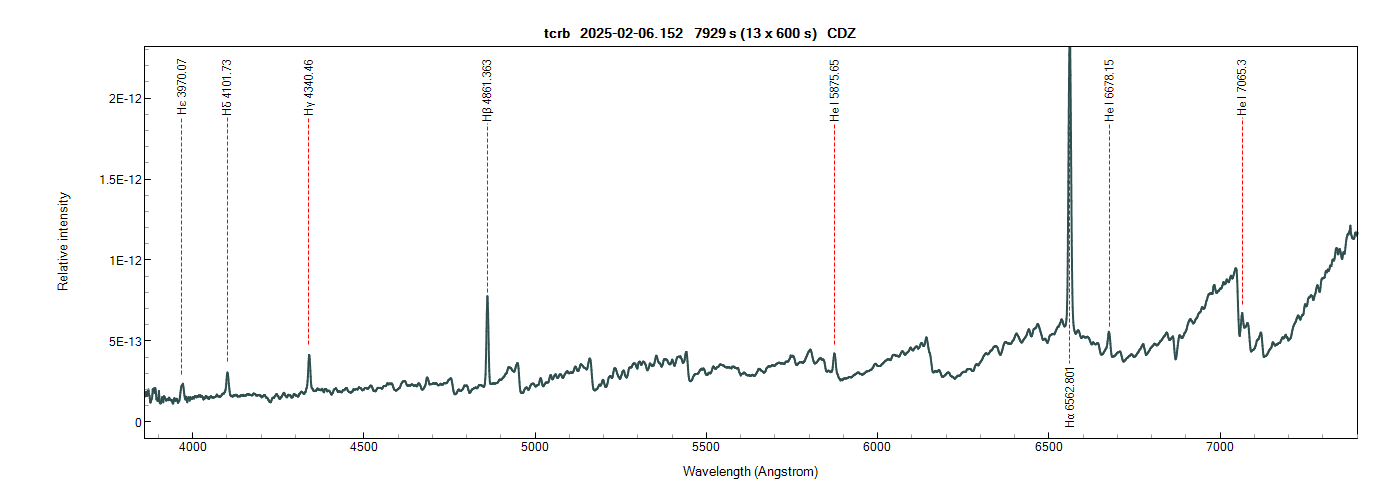
T Corona Borealis (T CrB) is one of the most closely watched objects in the current sky — a recurrent nova in symbiotic binary system anticipated to undergo a major outburst. This spectrum was captured from our facility in February 2025, showing the full Balmer series in emission (Hα through Hε) and the He I lines at 5876, 6678 and 7065 Å.
The dominant Hα feature at 6562.8 Å and the helium emission lines are characteristic of an accreting white dwarf system approaching an active phase. David obtained this over 13 × 600 s exposures — a total of nearly 2.2 hours of integration — from our La Palma site.
The difference — polluted sky vs La Palma
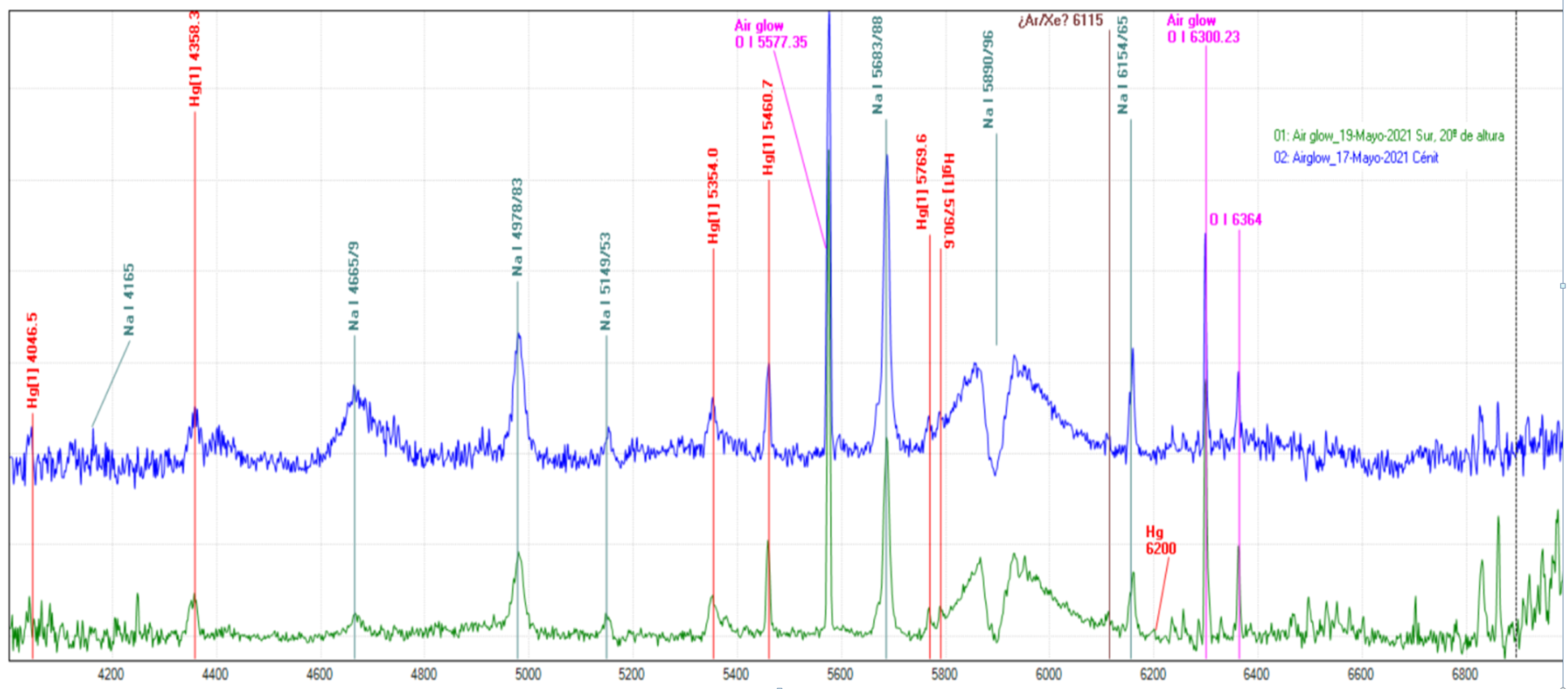
This spectrum was taken by David Cejudo from his home site for direct comparison. The contrast is dramatic: dozens of artificial emission lines crowd the spectrum — sodium doublets, mercury lines, and a broad LED continuum that raises the background across the entire optical range.
Sky subtraction at a polluted site means working against a structured, variable background full of sharp features. At La Palma, the sky spectrum above is all you have to deal with: four lines, two of them barely detectable, all natural. The difference in achievable signal-to-noise and spectral cleanliness is not marginal — it is fundamental.