Infrastructure
Built for precision astronomy
Every component of our facility is engineered for one purpose: giving your telescope the conditions and support it needs to perform at its best — remotely, autonomously, night after night.
above inversion layer
per hosting unit
+ surveillance
IAC 5-yr average
hybrid inverters
auto-balanced
Power system
60 kWh storage · zero-transition switching
Each hosting unit is connected to our LiFePO4 battery bank (60 kW) managed by hybrid solar inverters. Grid power and batteries work in parallel at all times — the inverters regulate and inject current continuously from both sources simultaneously.
The facility uses hybrid solar inverters with LiFePO4 battery storage (60 kW). Grid power and batteries work simultaneously — the inverters continuously inject current from both sources. There is no switchover, no interruption, and no detectable transition event. Your mount keeps tracking and your camera keeps exposing.
Per-pier power management — web app
Remote switching
Cut or restore power to individual outlets — telescope, mount, camera, focuser, dew heaters — from anywhere in the world.
Real-time metering
Live current draw per outlet. Spot abnormal consumption or a stuck motor instantly, without waiting for an alarm.
Leakage detection
Per-pier earth leakage monitoring. Protects your equipment and flags insulation faults before they become a problem.
All piers monitored
Every pier position is individually measured and controlled. Full visibility and control from the client portal — no interaction with on-site staff needed.
Environmental sensing
Multi-layer weather & sky monitoring
Protecting your equipment is as important as giving it a great sky. Our environmental monitoring system combines multiple independent sensor layers to detect changing conditions earlier than any single sensor could — and act before your equipment is at risk.
Acoustic rain & micro-droplet detection
Our proprietary precipitation system detects rainfall at the acoustic level — including ultra-fine aerosol droplets and micro-droplets that optical sensors miss entirely. The roof closes before standard rain gauges trigger. Developed and calibrated on site.
Dust & particle monitoring
Continuous atmospheric particle measurement detects calima intrusions (Saharan dust) in their early stages. Observation windows are flagged automatically when aerosol opacity exceeds acceptable thresholds for precision work.
Cloud detection with AI analysis
All-sky camera imagery processed by an AI model in real time classifies cloud coverage — distinguishing thin cirrus from cumulus, and estimating the clear-sky fraction available for observation. Updated every minute.
Sky temperature sensor
Infrared sky temperature monitoring detects cloud presence even before it appears in optical cameras. Sudden sky temperature rises signal incoming cloud cover and trigger precautionary roof closure protocol.
Rain detection project
Standard optical rain sensors react only when water accumulates on a surface. We found this too slow for protecting high-value equipment. Our own development — built and calibrated on site — uses acoustic analysis to characterise individual droplet impacts at the earliest possible moment.
The system classifies precipitation type and intensity continuously, differentiating between light mist, micro-droplet events, and genuine rainfall. It integrates with the roof controller so closure decisions are made in real time, based on what the sky is actually doing — not on whether enough water has pooled on a detector.
Structures
Observatories & pier foundations
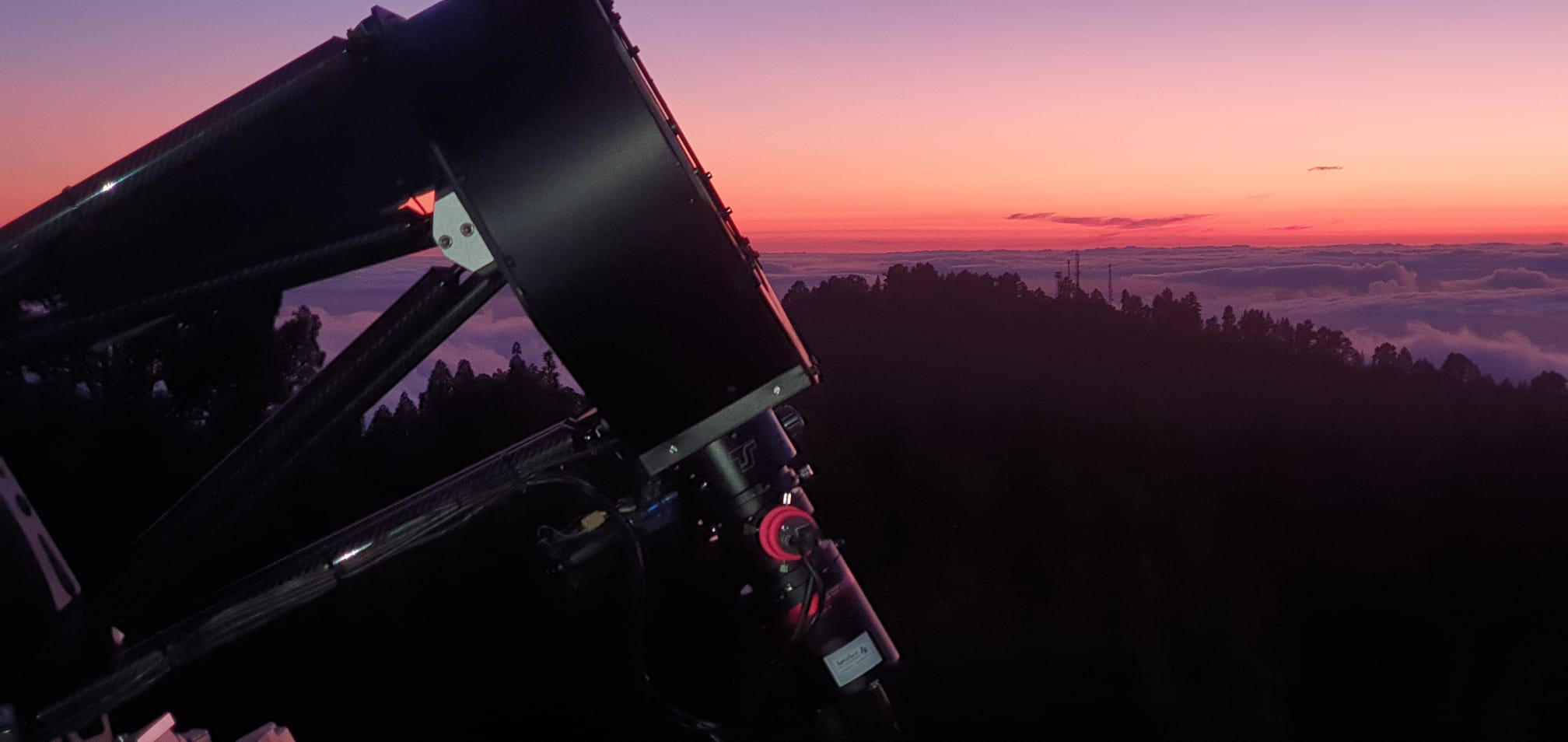
Our observatory structures are built for durability and thermal equilibration. The sliding roof with rock wool insulation minimises internal thermal mass, allowing the air to match outside temperature rapidly — critical for eliminating tube seeing that degrades star images. Rock wool also provides thermal isolation and complies with fire-prevention requirements in this protected area.
Pier foundations are reinforced concrete, mechanically isolated from the building structure to eliminate vibration coupling from floor traffic or wind. Load ratings are documented per pier position and available on request.
- Reinforced concrete piers — vibration isolated from structure
- Sliding roof with rock wool insulation — thermal isolation and fire prevention
- Thermal equilibration design — minimal seeing effects
- Load capacity up to 24″ standard — custom for larger
- Active dew prevention on all pier positions
- Structured cable management — no interference with mount movement
Security
24/7 surveillance & physical security
Your equipment is protected by a layered security system. Day and night surveillance cameras cover all areas of the facility, managed exclusively by Dark Sky Hosting — no third-party cloud services with access to your hardware.
On-site personnel provide round-the-clock supervision. Our monitoring is integrated with local authorities including the police and emergency services, ensuring rapid response to any incident.
- CCTV coverage — day and night, all areas
- On-site staff 24/7 — immediate incident response
- Integration with police and emergency services
- Access control — clients and authorised personnel only
- Climate-controlled environment protecting sensitive equipment
Connectivity
Secure remote access — your equipment, your control
Your software connects to your hardware exactly as it would on a local network — same latency, same commands, no middleman. Bandwidth is sufficient for simultaneous remote desktop sessions and high-volume data streaming. Clients who require VPN isolation can configure their own.
- Client-managed VPN support — full isolation
- Radioenlace 1G+1G + 2× Starlink + 2× LTE 4G+/5G — auto-balanced
- SSH access for custom automation and pipelines
- Compatible with INDI, ASCOM, ACP, N.I.N.A., SGP, Ekos and more
- FITS and XISF data transfer — no bandwidth throttling
Client portal — web app
Sky conditions
Exceptional meteorological conditions
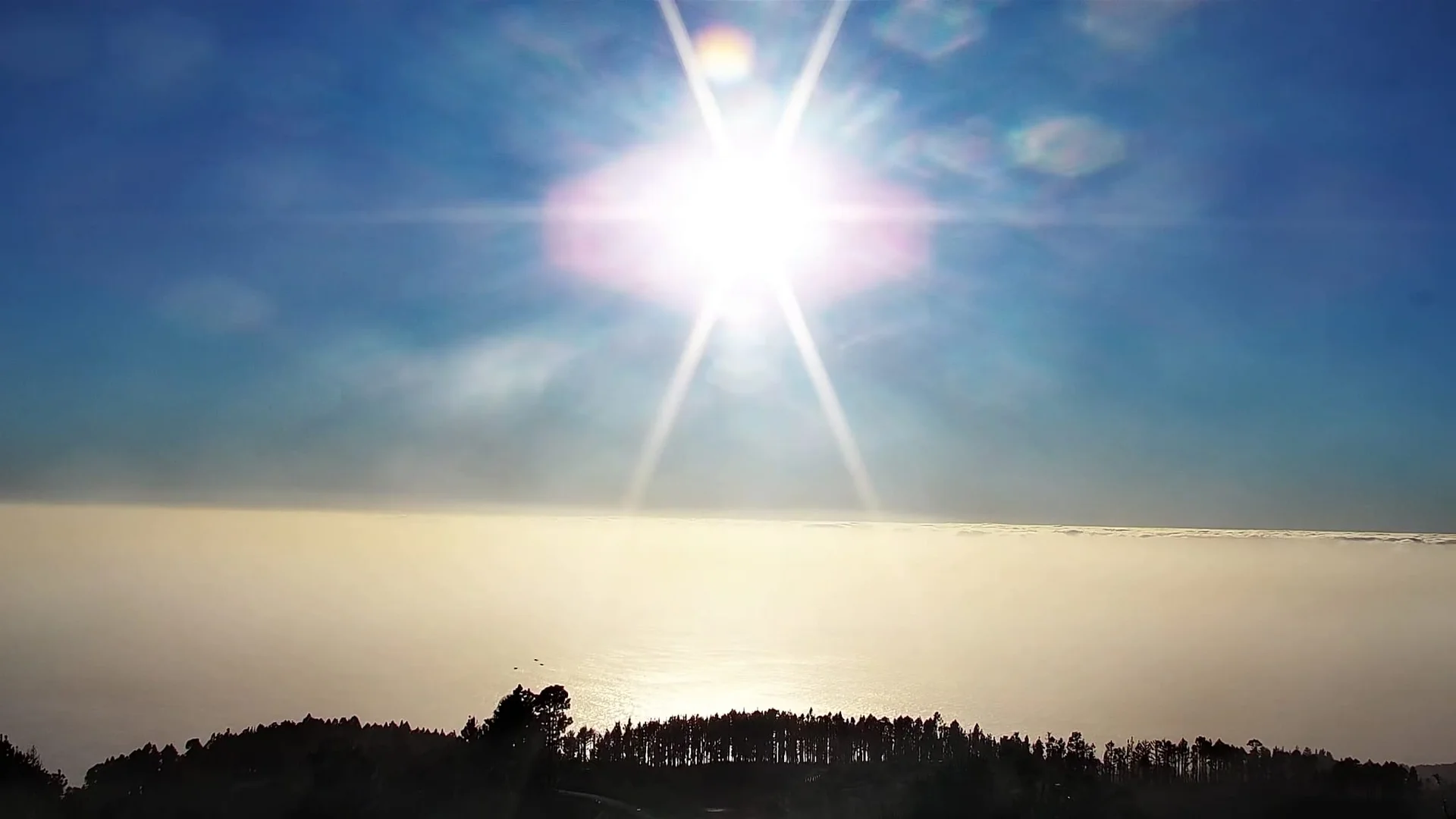
At 1,360 m altitude, above the marine inversion layer, the site benefits from the dry, stable air mass that descends from the Azores anticyclone. Atmospheric column depth is reduced, and ground-level humidity and light pollution are effectively blocked below.
The Canary Islands Sky Law (Law 31/1988) legally restricts light pollution, radio interference and air traffic over the observatories — a statutory protection unique in Europe, guaranteeing dark skies by law, not just geography.
- Sky brightness: SQM up to 22.03 mag/arcsec² — Bortle 1
- Median seeing: ~1 arcsec — above inversion layer
- Night humidity: 28% median — often below 15%
- Clear nights: 311+ per year (IAC 5-year average)
- Legally protected dark sky since 1988 — Law 31/1988
- UNESCO Starlight Reserve — La Palma, Canary Islands
Software & Integration
DarkSkyRoof — our own control platform
We built DarkSkyRoof in-house to give clients — and their software — complete, real-time control over the observatory environment. The result: a system that talks directly to N.I.N.A., SGP, ACP, Voyager and any other ASCOM-compatible automation platform without any additional configuration.
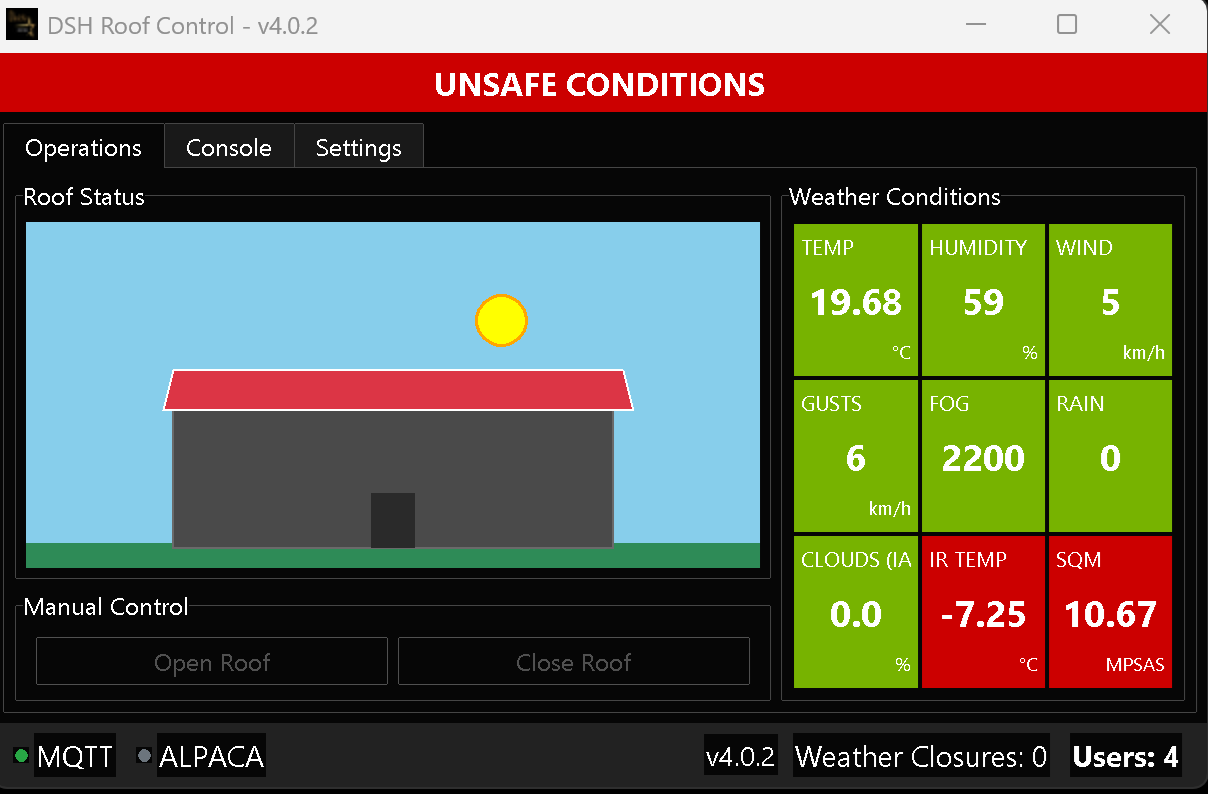
Live weather panel
Temperature, humidity, wind, gusts, fog, rain, cloud cover (AI), IR sky temperature and SQM — all in one view, updated in real time.
Roof control
Open and close the roof from anywhere — manually or automatically triggered by weather conditions. Visual status indicator shows current state at a glance.
Multi-user support
Multiple clients can connect simultaneously. Each session sees live status independently. MQTT and ALPACA protocols active concurrently.
Automatic closures
Configurable safety thresholds trigger automatic roof closure when wind, rain, humidity or cloud conditions exceed safe limits — independently of the client session.
ASCOM / ALPACA — native drivers
Your automation software connects directly
We developed custom ASCOM/ALPACA drivers for DarkSkyRoof. This means N.I.N.A., Sequence Generator Pro, ACP, Voyager, Cartes du Ciel and any other ASCOM-compatible platform can connect to our infrastructure — roof, safety monitor and weather — as if the hardware were local. Your software closes the roof automatically on unsafe conditions, reads live sky quality and dew point, and manages the shutter in sync with your imaging sequence. No manual intervention. No workarounds.
Dome / Roof driver
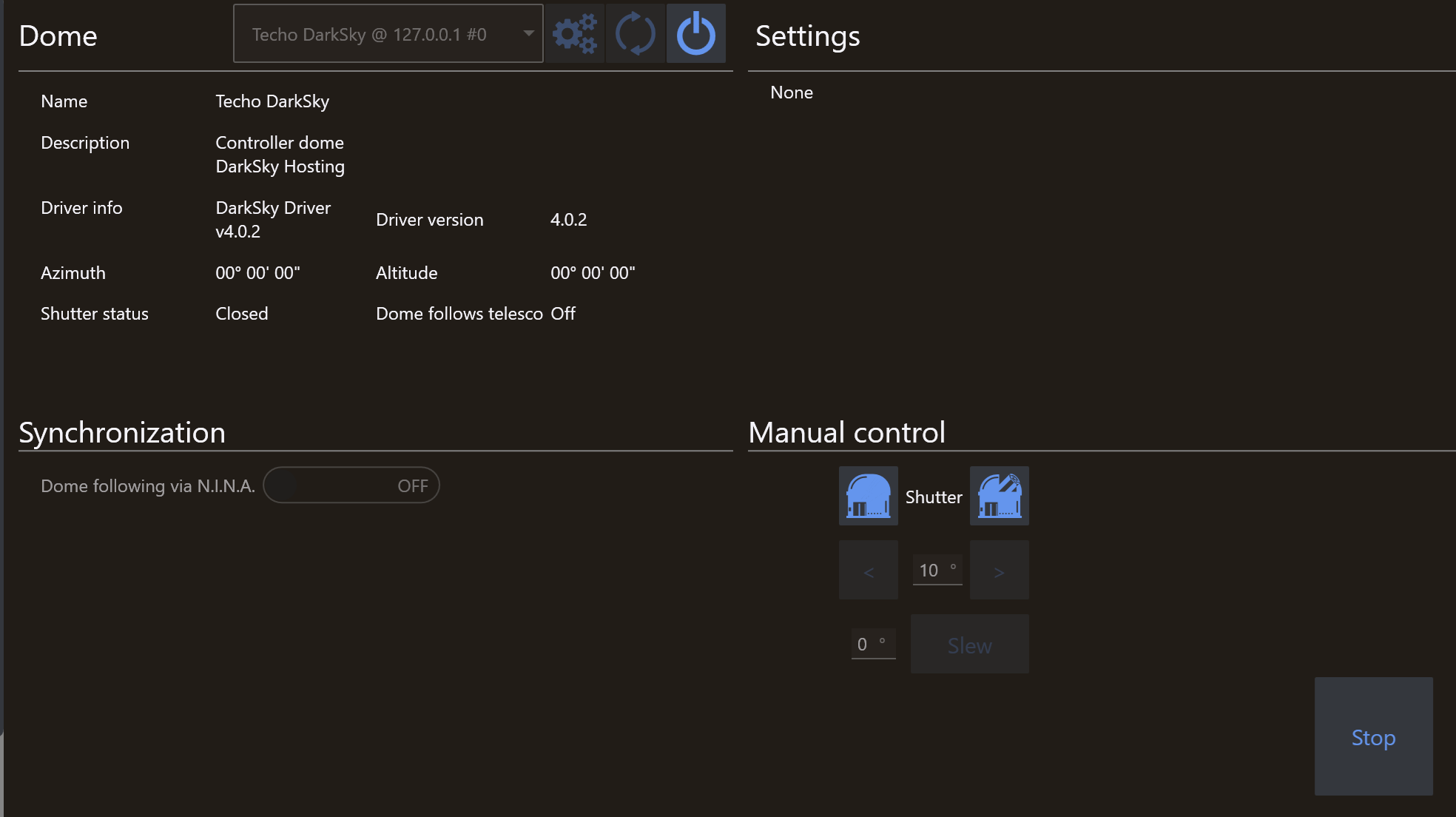
Roof control via N.I.N.A., SGP, ACP — shutter and weather safety integration
Observing conditions driver
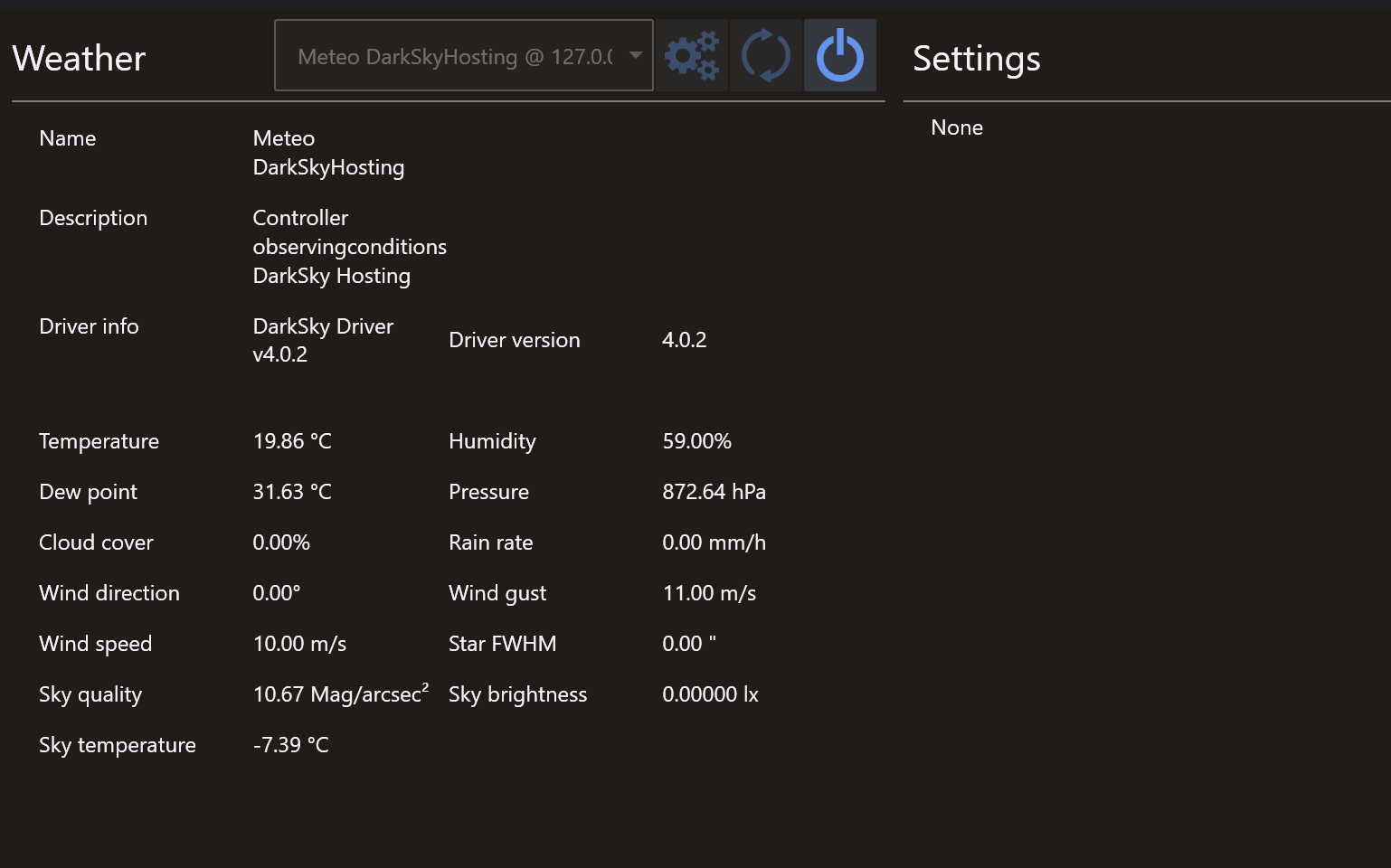
Full ASCOM ObservingConditions interface — temperature, humidity, wind, rain, SQM, sky temperature
Safety monitor driver
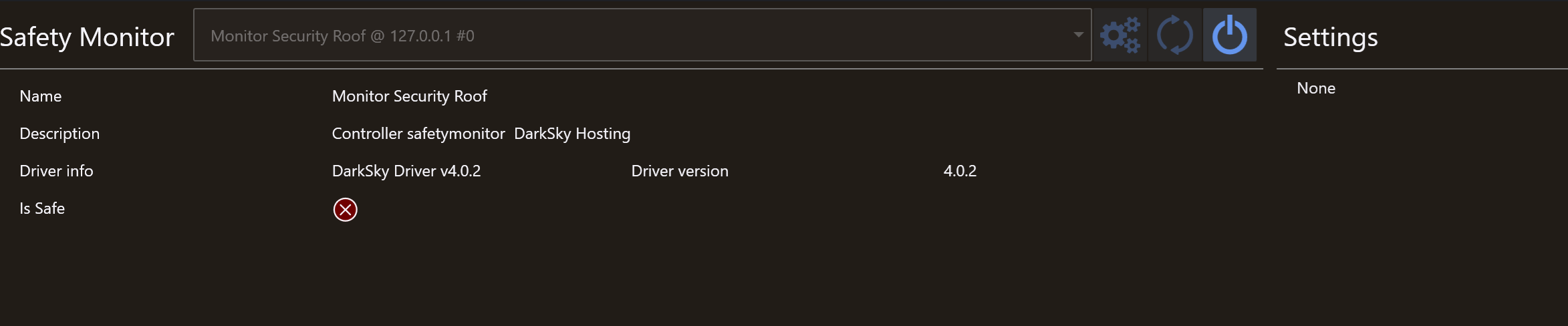
IsSafe flag fed directly into N.I.N.A. / SGP — your sequence pauses and the roof closes automatically when conditions are unsafe
Autonomous operation
Your telescope runs itself
All-sky & stellar cameras
Real-time sky transparency and cloud coverage monitoring. All clients have live access. Integrated with the automated roof interlock system.
Multi-sensor weather station
Wind speed/direction, temperature, humidity, dew point, barometric pressure, rain and dust sensors — all available via API for your automation scripts.
Motorised roof control
API-accessible roof control compatible with INDI, ASCOM and ACP. Automate fully: open at dusk, close on weather trigger, report status to your scheduler.
Per-outlet power control
Switch and monitor individual power outlets remotely. Leakage detection on every pier. Full control via the web client portal — no staff intervention needed.
Client portal
Web dashboard showing power consumption, current draw, battery level, roof status, weather data and camera feeds — from any browser, any device.
Software compatibility
Works over VPN with any software: INDI, ASCOM, Ekos, SGP, N.I.N.A., ACP, TheSkyX, Voyager, custom Python pipelines and more.
Get started
Ready to find your pier?
Select a hosting plan based on your telescope aperture, or contact us to discuss your specific setup and requirements.
View hosting plans → Contact us