
Full Observatory Conditions
Loading…
Loading observatory status…
🔭 Seeing & Atmosphere
Forecast seeing–
Transparency–
Lifted index–
Visibility–
AI seeing estimate–
Star quality (AI)–
☁️ Cloud Cover
AI cloud cover–
Cloud trend–
Quadrant affected–
Forecast clouds (7t)–
Forecast clouds (om)–
Prediction 1h–
💨 Wind & Surface
Wind speed–
Gusts–
Upper atm. (850 hPa)–
Temperature–
Humidity–
Dew point–
⭐ Sky Quality
SQM (sensor)–
Cloud sensor (ΔT)–
AI confidence–
Sky scene (AI)–
Precip. probability–
Sky color (AI)–
🌫️ Calima & Aerosols
Status–
AOD (opacity)–
Dust µg/m³–
PM10 µg/m³–
AOD<0.1 = clear · 0.1–0.3 = haze · >0.3 = dust event
🌧️ Rain Station
Status–
Today acc.–
Rate last 1h–
Dew point acc.–
Data quality–
Current Observatory Conditions
Loading…
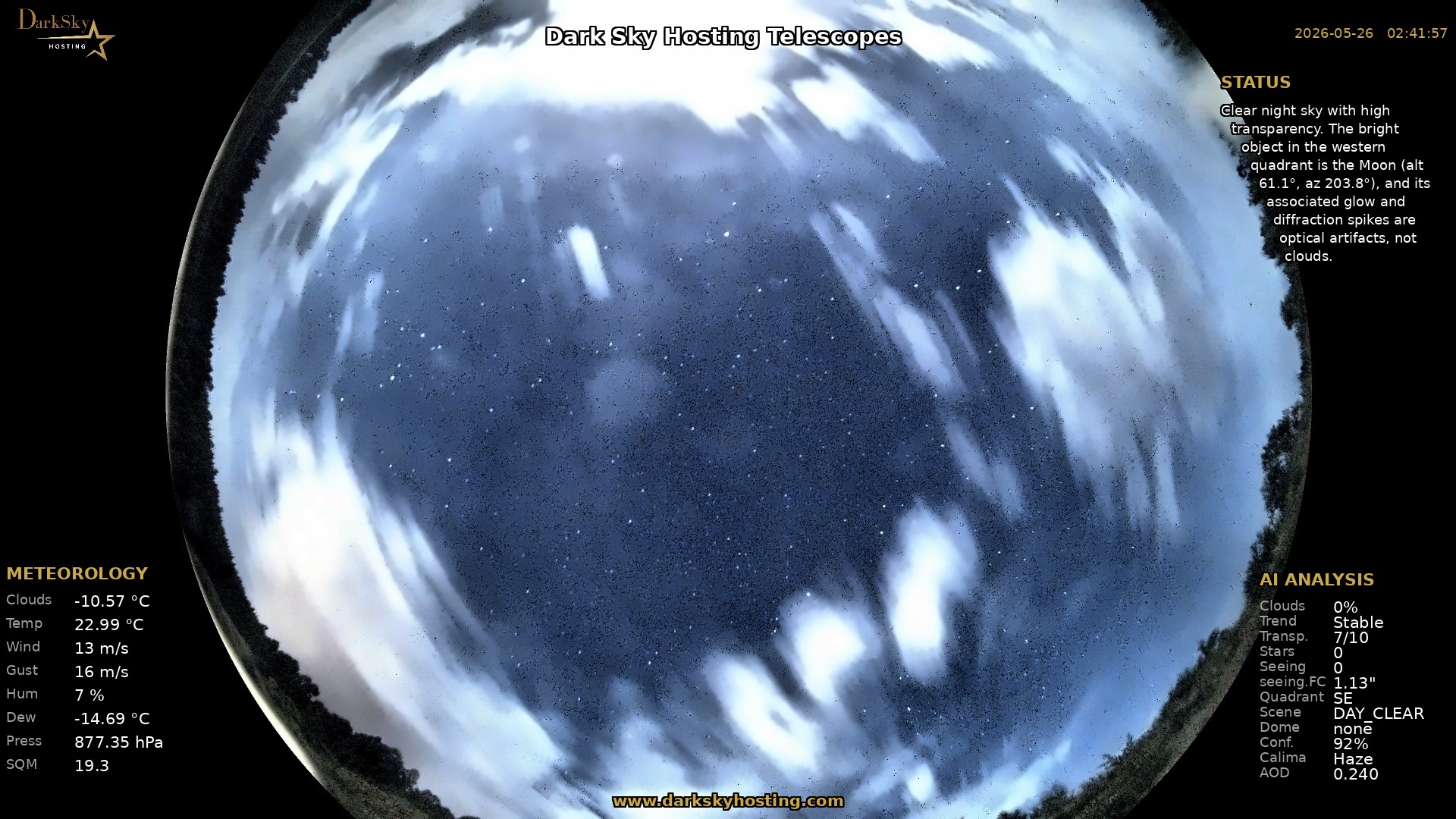
All-sky · La Palma · updates every 60s
–
°C
Temperature
–
%
Humidity
–
km/h
Wind
–
km/h
Gusts
–
SQM
Sky Quality
–
ΔT °C
Cloud sensor
Fetching data…
⭐ Verified Sky Data · La Palma 2025
The Numbers Behind Our Sky
Real measurements from our on-site weather station · 786,000+ data points · All values independently verifiable
311
Useful nights / year
≥1h of clear, safe conditions
85%
Clear night rate
287 nights · cloudsSafe sensor
21.75
SQM mean · new moon
mag/arcsec² · all-year average
22.03
SQM peak · winter
Confirmed manual measurement
☀ Clear nights per month
✩ SQM seasonal curve · new moon
📊 Monthly conditions
| Month | Clear | Temp °C | Hum | Wind km/h | SQM New Moon | Milky Way |
|---|
ⓘ Why SQM varies seasonally — the Milky Way effect
The SQM measures total sky brightness — including the Milky Way. When the galactic core rises (Jun–Sep), it contributes diffuse glow, slightly lowering readings (∼21.57 in August). In winter, the sky reaches peak darkness (up to 22.03 in February). This seasonal variation is only detectable at the world’s darkest sites. Our sky is so dark that the Milky Way itself is the primary source of sky brightness in summer.